

Writing a 10,000-word dissertation can feel overwhelming — I’ve been there! To make the process easier for others, I’ve broken down the steps I followed, and shared the tips that helped me achieve a first-class grade while staying organised and (mostly) stress-free!

Please note that this guide is based on my quantitative marketing dissertation, titled “The Impact of Celebrity Endorsers’ Characteristics on Gen Z’s Purchase Intentions in the UK Apparel Fashion Industry.” This is intended as a general guide, so always refer to your own module brief and marking criteria to make sure your structure aligns.
DISSERTATION STRUCTURE:
💡Tip: Write your abstract last — it’s a summary of your study placed at the start of your dissertation and doesn’t count towards your word count.
Section 1: Background and context (Approximately 1,500 words)
This section introduces your study and sets the scene. These are the sub-headings I used to guide my structure:
- Introduction
- Research background
- Research rationale
- Research aim
- Research objectives
- Structure of the study
For me, this was where I explained the growing influence of celebrity endorsements on Gen Z consumers and why this topic is important in today’s fashion marketing landscape.
💡 Tips:
- Keep this section clear and engaging — show the reader what your study is about and why it’s worth exploring right from the start.
- Make sure to use LOTS of recent, credible, and relevant academic sources to back up your statements!
- Don't forget to write in the present tense!
Section 2: Literature review (Approximately 3,500 words)
The literature review has two main purposes:
1. To demonstrate your knowledge of the subject area
2. To inform your empirical research
Make sure to use recent, credible, and relevant academic sources throughout!
For my dissertation, I structured the literature review into the following sub-sections:
- Introduction
- Celebrity endorsers
- Celebrity endorsers in the apparel fashion industry
- Celebrity endorsers and Gen Z’s purchase intentions in the apparel fashion industry
- Theoretical model (I used the source credibility theory – SCT)
- Attractiveness
- Trustworthiness
- Expertise
- Purchase Intention
- Research gaps
- Conceptual framework
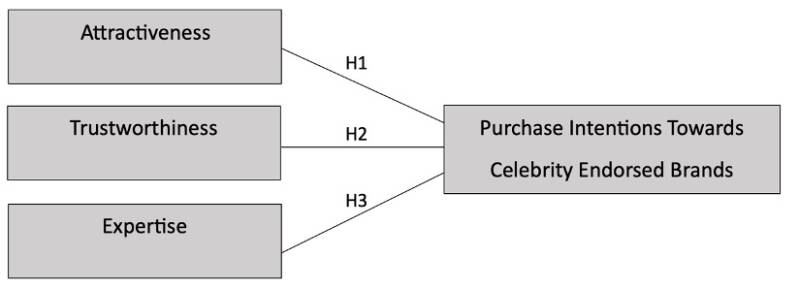
Below is my conceptual framework to show how my hypotheses were developed:
💡 Tip: Use academic journals to back up your points and highlight any inconsistencies or unanswered questions in past research. That’s where your study adds value! Also, don't forget to write in the present tense!
Section 3: Methodology (Approximately 1,500 words)
This chapter explains how you carried out your research. These are the sub-headings I used:
- Introduction
- Philosophical stance
- Research approach
- Data collection
- Sampling strategy
- Constructs, measures & scales
- Data analysis
- Ethical considerations
Since my study was quantitative, I used an online Qualtrics survey to collect data from Gen Z participants aged 18–28, ensuring ethical compliance by excluding those under 18.
💡 Tip: Always justify your choices — explain why your methods suit your research aims. Also, don't forget to write in the past tense!
Section 4: Results and analysis (Approximately 1,500 words)
Now comes the fun (and confusing) part – analysing your data! I used SPSS (Statistical Package for the Social Sciences) for the analysis.
Start with an introduction, then this is what I covered:
- Descriptive statistics (e.g., sample profile and key data insights)
- Cronbach’s alpha reliability test
- Exploratory factor analysis
- Pearson correlation analysis
- Multiple linear regression analysis (including R-value, ANOVA, and regression outputs)
- Hypothesis results (to make this clearer, I presented the information in a table.)
- Summary (of your main findings).
💡 Tip: Present your data clearly — use tables and charts to make it easier for readers to follow. Also, don't forget to write in the past tense!
Note: Due to ethical considerations, I haven’t shared my full findings here. However, if you’d like more guidance, feel free to get in touch — I know this section can be tricky!
Section 5: Discussion (Approximately 2,000 words)
This is where you bring everything together and interpret your findings. Sub-headings you might want to include:
- Introduction
- Theoretical implications
- Managerial implications
- Limitations & recommendations for future research
- Conclusion
For example, I discussed how my results (hypotheses) supported parts of the Source Credibility Theory and what this means for fashion brands using celebrities to reach Gen Z consumers.
💡 Tip: Reflect honestly on what went well and what could be improved — demonstrating self-awareness and critical thinking is key. This section is now back to the present tense!
Final sections to think about!
Don’t forget your reference list and appendices! These are essential parts of your dissertation, but they don’t count towards your word count.
My advice and extra tips:
- Choose a topic you’re genuinely interested in – it’ll make the whole process far more enjoyable and less of a struggle.
- Choose a topic that’s been researched enough to provide plenty of secondary sources, but not so much that it’s impossible to identify your own research gap.
- Avoid relying too heavily on tools like ChatGPT. While they can seem like an easy shortcut, the references are often inaccurate or incorrectly formatted, and the language can sound noticeably artificial.
- Start early. Giving yourself plenty of time to research, write, and refine will make a huge difference to the quality of your work (and your stress levels!).
- Don’t get too hung up on the word count — use it as a rough guide and focus on clearly getting your ideas across.
- Make the most of your supervisor meetings. Attend every session, come prepared, and ask as many questions as possible — after all, they’re the ones marking your dissertation!
💭 Final thoughts:
Writing a dissertation is a huge challenge, but taking it one chapter at a time makes it achievable. Hopefully, this step-by-step guide helps simplify the process and gives you a clearer picture of what to expect from a quantitative marketing dissertation.
If you’re struggling or just need a bit of guidance, don’t hesitate to reach out — you’ve got this!
Add comment
Comments