

In a world where social media influences everything we do — from our purchasing habits to our self-esteem, The Social Dilemma (a 2020 Netflix documentary) acts as a powerful wake-up call.
The documentary combines expert interviews, alongside a fictional family storyline, to show how digital platforms shape our thoughts, emotions, and actions — often without us even realising.
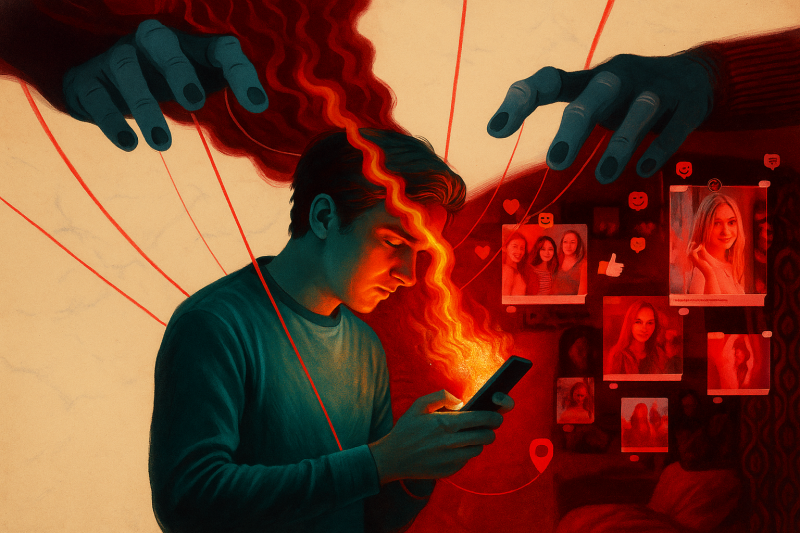
1. What 'The Social Dilemma' Reveals:
The documentary features former senior employees from major platforms, including Twitter, Pinterest, Instagram, Facebook and Google. Together, they expose the uncomfortable truth behind “free” social media:
- Our attention is the product. Since advertisers pay for our time, platforms optimise everything to keep us scrolling as long as possible.
- Everything is tracked. Every pause, click, view, like, and share is measured and recorded. Platforms even track how long we look at a photo!
- They know who we are. Algorithms can infer mood, personality traits, loneliness, confidence levels, and emotional vulnerabilities.
- No organisation in history has held this much personal data. The documentary stresses the scale and unprecedented nature of this information.
- Machine-learning predictions. User data feeds into systems that continually improve at predicting what we will do next — with no human oversight.
- A new landscape of manipulation. With online interactions becoming primary for younger generations, third parties (advertisers, political groups, foreign governments) can influence beliefs and behaviour at scale.
- Beauty standards and identity harm. Filter culture is driving some people to seek plastic surgery to look like their edited selfies/snapchat filters, affecting self-worth and mental health.
- ‘Fake, brutal popularity’- Chamath Palihapitiya. Likes and thumbs up features serve as psychological rewards, reinforcing a cycle of perfection and comparison.
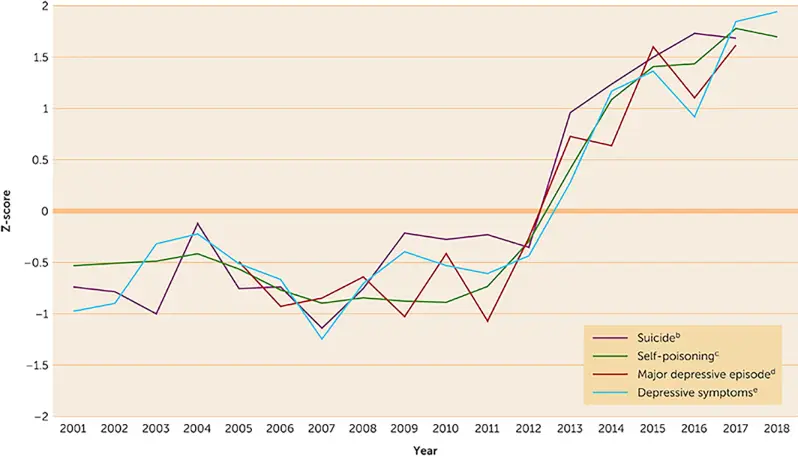
- A mental health crisis. Teen anxiety, depression, and self-harm rates sharply increased from 2010, aligning with the rise of social media use among Gen Z (shown in the graph below).
- Misinformation spreads faster than truth. MIT research showed fake news spreads six times faster than real news on Twitter, because sensational content draws more engagement.
- Democratic consequences. The documentary links social media to political manipulation, including the 2016 U.S. election. Stating, Russia didn’t hack Facebook — they used its advertising tools to sow division and distrust, just like “remote-control warfare.”
2. The Online Model: How the System Works
This section explains how these platforms achieve such influence.
Algorithms and Predictions
- Social media companies build detailed models of users based on cumulative activity — likes, clicks, watch time, search history.
- The more we interact, the more accurate the model becomes at predicting our preferences, triggers, and future behaviour.
The Three Core Objectives
All major platforms optimise for:
- Engagement– keeping you online as long as possible.
- Growth– encouraging you to return and invite friends.
- Advertising– showing you targeted ads to make money.
Algorithms determine exactly what to show you to fulfil these goals.
Designing for Addiction
- Features like infinite scroll, pull-to-refresh, notifications, tagging, comments, and the “typing…” indicator exploit deep psychological instincts.
- The constant “slot-machine effect” (refresh = a new surprise) keeps users hooked — an intentional design technique.
- Platforms such as Facebook and Google continually experiment with tiny tweaks to interface design to see how users react, then optimise for increased engagement.
Manipulation Without Awareness
- Algorithms shape emotions and behaviour outside the app, influencing real-world attitudes, purchases, moods, and beliefs.
- Users rarely realise how much data is harvested or how it is monetised.
Even the creators aren’t immune
- Executives and engineers who helped design these systems admit they fall for the same addictive mechanisms — proving how powerful the design is.
A Generation Raised on Screens
- Many young people now turn to their phones whenever bored, lonely, or anxious — reinforcing dependence on digital validation.
The Real AI Takeover
- People often fear a future where AI takes over through robots or physical machines. The documentary argues that AI already influences society — just invisibly, through feeds and algorithms.
Loss of Control
- Only a handful of engineers understand the algorithms deeply, and even they acknowledge that the systems evolve beyond human comprehension.
⚠️Tristan Harris’s Warning! ⚠️
- Computing power increased a trillion-fold from 1960 to 2020, while the human brain has not evolved at all during this time.
- We worry about when technology surpasses human strength, but the danger comes earlier: when technology exploits human weakness.
- This leads to addiction, polarisation, and radicalisation — the point he describes as “checkmate for humanity.”
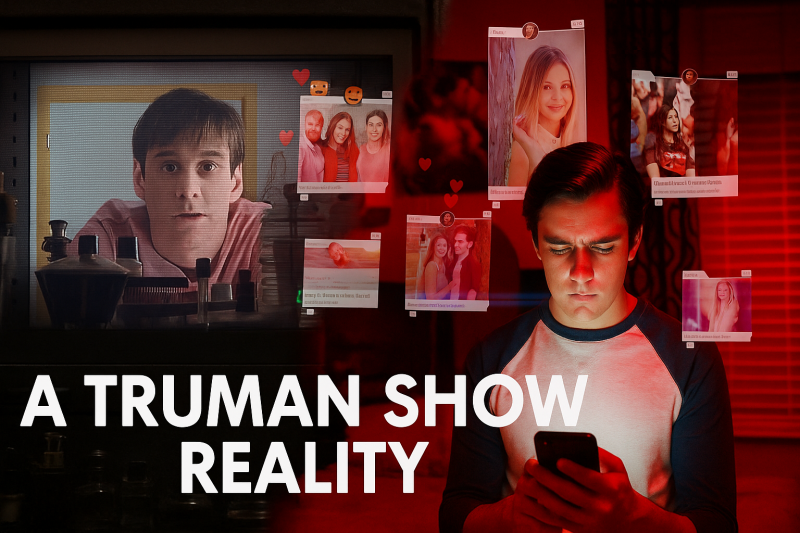
A Truman Show Reality
- We accept the digital world presented to us without question — unaware of how curated and manipulated it truly is.
3. Key quotes from the documentary
- “If you’re not paying for the product, you are the product.” — Tristan Harris
- “It’s the gradual, slight, imperceptible change in your own behaviour that is the product.”
- “Social media is a drug.”
- “Any sufficiently advanced technology is indistinguishable from magic.” — Arthur C. Clarke
- “There are only two industries that refer to their customers as ‘users’: illegal drugs and software.” — Edward Tufte
- “How do you wake up from the matrix when you don’t know you’re in the matrix?” — Tristan Harris
Take a look at the trailer!
4. The attention economy: why our time is the product
Social media runs on a simple model: the longer we stay online, the more ads we see, and the more money platforms make.
Key insights:
- Emotional content (shock, outrage, humour) is prioritised because it keeps us engaged.
- Infinite scroll, push notifications, and personalised feeds are intentionally designed habit-hooks.
- Marketers now compete with every other piece of content on a user’s screen.
- This forces brands to create value-driven, meaningful content rather than simply trying to hijack attention.
5. How algorithms shape consumer behaviour
For Marketers
- Hyper-targeted ads boost efficiency but blur the line between persuasion and manipulation.
- Data-driven personalisation allows extremely niche audience targeting.
- Ethical considerations are rising: well-being, transparency, and informed consent matter more than ever.
For Users
- Feeds reinforce existing beliefs (filter bubbles).
- Purchases often feel “natural” but are heavily nudged.
- Choices feel autonomous yet are shaped by invisible recommendation systems.
6. The psychological impact: when digital design meets the human brain
Effects on Users
- Anxiety, comparison culture, and low self-esteem
- Pressure to curate a flawless digital self
- Difficulty switching off and reduced attention span
- Emotional dependence on online validation
Effects on Brands
- Consumers are increasingly sceptical of manipulative tactics.
- Authenticity, transparency, and responsible messaging are now competitive advantages.
- Brands that prioritise wellbeing over engagement build stronger loyalty — especially among Gen Z.
7. Ethical marketing: the opportunity in the crisis
Ethical strategies:
- Prioritise transparency over manipulation
- Aim for meaningful engagement rather than clickbait
- Use data responsibly and respect privacy
- Create content that informs, empowers, or educates
- Recognise the psychological impact of digital design choices
8. Navigating digital life: practical tips for consumers
To reduce algorithmic influence:
- Turn off non-essential notifications
- Limit screen time or set app boundaries
- Diversify the accounts you follow
- Fact-check content before sharing
- Reflect on how targeted advertising affects your choices
💭Final thoughts: a shared responsibility
The Social Dilemma is not an attack on technology — it’s a reminder that the relationship between platforms, marketers, and consumers must evolve.
- Technology will continue shaping our lives.
- Marketers must use their influence ethically.
- Consumers must stay aware and intentional.
This is a HUGE amount of information and A LOT to take in! But it’s definitely time we start talking about this more and become more aware of how much time we spend on our phones! What do you think? Leave a comment below!
Add comment
Comments